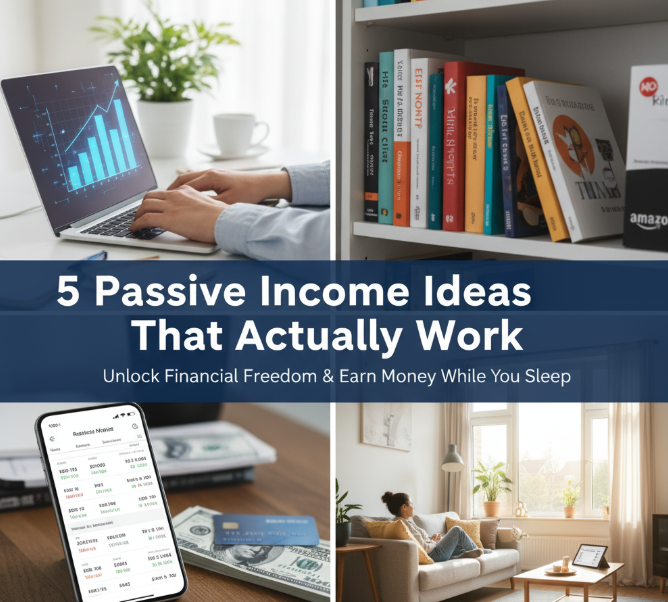

Money while you sleep. Not exactly your average vision of paradise, right? But thousands of ordinary people are already doing it. They’re not wealthy business tycoons or tech gurus. They are teachers, nurses, college students and parents who figured out how to pick up extra money without having to trade every hour for a dollar.
The reality is, passive income isn’t for people who are looking to get rich quick. It’s about setting up systems that will continue to pay you even when you’re no longer actively working. Think of it like growing a tree: You do the hard stuff up front, water and fertilize it constantly, and eventually it grows strong enough to bear you fruit year after year.
In today’s guide, we’re going to cut through the noise and teach you 5 realistic proven ways that actual people make real passive income streams! No scams, no pyramid schemes, only honest pieces of mind that work if you work it as long as you can put a little effort in yourself up front.
What Makes Passive Income “Real”?
Before we get into the ideas, some clarification is in order. Real passive income is earned by doing the work upfront. Anybody who is promising you to earn easy money with no investments (not necessarily of money) as a first investment, is probably selling you snake oil.
True passive income has three characteristics:
Initial effort required – You will need to put in time, money or both initially.
Low maintenance – It runs with minimal daily intervention once installed.
Massive income potential – Earn more money without having to work more hours.
So now that we have realistic expectations, here are five workable strategies.
1. The Best Way to Invest in Rental Properties
Real estate has produced more millionaires than anything else. But you don’t need millions to get started, and you don’t have to end up as a landlord dealing with midnight flush problems.
Traditional Long-Term Rentals
Buy a property and rent it out: That’s the oldest trick in the book. Here’s why it still works:
You have rental property, so your tenants are the ones who actually pay down your mortgage. Over time you gain equity in the property and receive monthly rent checks. The math is relatively simple — if your rent is greater than your monthly expenses (mortgage, taxes, insurance, maintenance), you’re seeing money while you sleep.
The Real Numbers:
Suppose you buy a $200,000 home with a $40,000 down payment (20 percent). It could be that your monthly mortgage is about $1,200. If you can rent it for $1,800 a month, then that is up to $600 in potential monthly profit — or $7,200 per year.
| Expense Category | Monthly Cost |
|---|---|
| Mortgage Payment | $1,200 |
| Property Tax | $250 |
| Insurance | $100 |
| Maintenance Fund | $150 |
| Total Expenses | $1,700 |
| Rental Income | $1,800 |
| Net Profit | $100 |
Now, $100 might not seem like a lot, but keep in mind — your tenant is also paying down that mortgage principal for you. That’s equity building in your favor. And, of course, property values tend to appreciate.
Short-Term Vacation Rentals
Enter platforms like Airbnb and Vrbo, which brought the game to a whole new level. There is a lot of money to be made with short-term rentals. If you own property in a tourist area or hot city, your cash flow could be much stronger than it would have been under traditional leases.
If the cash flow from a long-term rental renting for $1,500 a month were nine times less and you rented it out as a vacation rental at $150 per night. For a mere 15 nights a month of renting it, that is $2,250 — or half again as much income.
The catch? Short-term rentals require more management. You’ll need to handle:
- Guest communications
- Cleaning between stays
- Key exchanges
- Maintenance issues
Many successful Airbnb hosts actually outsource those tasks to property managers and they keep their income 100% passive and they pay a middleman 15-25% of the revenue.
Getting Started Without Buying Property
No $40,000 for a down payment? Consider these alternatives:
Rent Arbitrage: Rent a long-term property, then sub-rent as an Airbnb for profit. Some people create full businesses this way.
House Hacking: Purchase a multi-unit property, occupy one unit and rent out the others. Your tenants pay your mortgage and you live for free — or cheap.
Real Estate Investment Trusts (REITs): Get into real estate without purchasing a property. REITs are businesses that own income-generating real estate. You buy shares similar to stocks and earn dividends. Some look to get 4-7% dividends annually.
Real Estate’s Bottom Line
Pros:
- Tangible asset that typically appreciates
- Diversified income streams (rent + equity + tax benefits)
- Inflation-resistant
Cons:
- Requires significant upfront capital
- Property management can be time-consuming
- Market shifts may impact the value of property
- Surprise expenses (e.g. new roof, broken HVAC)
Time Until Passive: 6-12 months of initial setup, then 2-5 hours a month (with good property management)
2. Dividend Stocks: Make Money While You Sleep
If real estate feels too hands-on or capital-intensive, dividend stocks are a more passive source of income. When you have big dividend stocks, companies just pay you, their shareholder, out of the profits they make.
How Dividend Investing Works
Steady earners at companies often reward these companies’ shareholders with regular dividend payments on a quarterly basis. It’s their way of saying ‘thanks for investing in us.’
So, for instance, if you own 100 shares of a company that is trading at $50 per share ($5,000 investment) and pays a 4% annual dividend, you’d get $200 total per year worth of dividends — generally parceling up into four payments of $50 each.
Building a Dividend Portfolio
The secret to making dividends work for you is creating a diversified portfolio of stalwart companies. Here’s a simple approach:
Dividend Aristocrats: The members of the S&P 500 companies that have raised dividends every year for at least the last quarter-century. You just can’t beat them for reliability. You can still find company after company that has been steadily raising its dividend for 20 or even 40 years — think Coca-Cola, Johnson & Johnson and Procter & Gamble.
High-Yield Dividend Stocks: There are companies whose dividends are 5–8% or more. These can be winsome, though higher yields often bring greater risk. Ensure that the company can continue to make those payments.
Dividend Growth Stocks: Look for loyal payers that have increased dividends each year. A 3% yield today that grows at an annual rate of 10% will beat a 5% yield that remains static.
The Power of Dividend Reinvestment
Here’s where things get exciting. Most every broker lets you set up automatic dividend reinvestment plans, or DRIPs. Instead of paying you cash, your dividends automatically buy more shares.
This creates compound growth. Your dividends buy more shares, which produce more dividends, which buy additional shares. The snowball effect can be potent over time.
Example Growth Scenario:
| Year | Portfolio Value | Annual Dividend (4%) | # Of Shares Owned |
|---|---|---|---|
| 1 | $10,000 | $400 | 200 |
| 5 | $12,167 | $487 | 243 |
| 10 | $14,802 | $592 | 296 |
| 20 | $21,911 | $876 | 438 |
| 30 | $32,434 | $1,297 | 649 |
Assumes 4% dividend yield, 10% annual dividend reinvestment, and zero stock price growth (this is really conservative)
Index Funds And ETFs: The Easy Button
Not interested in choosing individual stocks? Index funds and exchange-traded funds that focus on dividends offer instant diversification.
Popular options include:
- Vanguard Dividend Appreciation ETF (VIG): Focuses on companies that have a record of growing dividends
- Schwab U.S. Dividend Equity ETF (SCHD): Quality dividend names at a lower price tag
- SPDR S&P Dividend ETF (SDY): Follows the S&P High Yield Dividend Aristocrats Index
These have historically cost between 0.03% and 0.35% a year, offering exposure to dozens or hundreds of dividend-paying companies.
Tax Considerations
Qualified dividends are taxed at a special rate in the U.S. Hold stocks for more than 60 days and, rather than being taxed as ordinary income (which tops out at up to 37 percent for the richest Americans), your dividends are taxed at a lower rate — capital gains rates of 0 percent, 15 or 20 percent. That’s a significant advantage.
-
🪙 Looking for safe and steady investment ideas? Check out: Safe Investments for Steady Long-Term Growth
The Bottom Line on Dividend Stocks
Pros:
- Minimal investment amount (begin with $100)
- Genuine “set it and forget it” income
- High liquidity (sell anytime)
- Compounds automatically with DRIPs
Cons:
- Dividends aren’t guaranteed (companies can reduce them)
- Market volatility affects portfolio value
- You have to spend money to make money (lots of it)
- Years needed to start making real money
Time Until Passive: Instant once investment, contributions time-aggregated daily or weekly (up to you) recommended
3. Digital Products: Create Once, Sell Forever
And now, here’s where it gets delicious. Digital products allow you to make something once and sell it thousands of times over with no inventory, shipping or production cost.
Kinds of Digital Products You Can Sell
Online Courses: If you know something — how to cook, take a picture, market a product, play the guitar — you can teach it online. Your courses and payments are hosted on platforms such as Udemy, Teachable and Skillshare.
A good course can be sold for $50–$200 and still sells for years with little more than cursory updates. Some course creators make $5,000-$50,000 per month from the courses they originally created years ago.
eBooks and Guides: Amazon Kindle Direct Publishing — Make your book available on the Kindle and earn up to 70 percent in royalties. No publisher needed. Best sellers include romance, self-help and how-to guides.
Writers typically receive $2 to $7 for each book sold, depending on pricing. Successful authors produce multiple books and build a library that earns them a steady income.
Templates and Printables: It seems that in the world of Etsy, there are as many sellers who specialize in planners, wedding invites and resume templates as people who just design flyers, business cards and dozens of other printables. Design once, sell forever.
Best-selling vendors earn $2k-10k month using easy PDF templates that cost $5-$25 to make.
Stock Photography and Video: If you have a good eye, put your photos and videos up on stock sites like Shutterstock, Adobe Stock or Getty Images. You get a royalty each time someone downloads your work.
For photographers with libraries (500+ images) photographers can earn $500-$5,000+ a month in passive royalties.
Music and Audio: Musicians could upload tracks to a place like AudioJungle or Pond5. Businesses have a commercial need for background music on videos, presentations and commercials. Thanks to your first take, your songs might score YouTube videos for decades.
Creating Your First Digital Product
Here’s a practical roadmap:
Step 1: Know Your Knowledge – What are people always asking you about? What do you know how to do that others would like to learn? You don’t have to really be all that great, just good enough to solve someone’s problem.
Step 2: Validate the Idea – Don’t spend weeks building something without verifying that people will buy it. Look for comparable items on Amazon, Udemy or Etsy. If products like that exist and they sell, there’s a market.
Step 3: Create Quality Content – This is the part you give time for. Be it recording a course or writing an eBook, or even creating templates – quality is key. Sloppy goods that make people miserable get poor reviews and don’t sell.
Step 4: Choose Your Platform
- Udemy/Skillshare: Great for courses, you don’t worry about marketing
- Gumroad/Teachable: More control but you do your own marketing
- Amazon KDP: Most intuitive for books, huge built-in audience
- Etsy: If you are into printables and templates
Step 5: Launch and Market – Write a great product description, use the right keywords that people are searching for, and you may even want to do initial promotions to help get those first reviews.
The Marketing Reality
Here’s the harsh reality: few digital products will earn you passive income unless you already have an audience, or killer search engine placement. The first few months involve active marketing — social media, email lists, blogging or paid ads.
When you build momentum, and get a large number of good reviews, sales actually start becoming more automatic.
The Bottom Line on Digital Products
Pros:
- Zero inventory or production costs
- Unlimited scalability (sell to millions)
- High profit margins (80-95%)
- Creative and fulfilling work
Cons:
- Significant upfront time investment
- Competitive markets
- Requires marketing skills
- Income can fluctuate
Time Until Passive: 3-6 months of creation and promotion, then become more passive with few updates accomplished
4. Affiliate Marketing – Make Money While You Sleep!
Affiliate marketing is you recommending stuff you love and getting a commission from sales that happen from your unique link. It’s performance-based advertising, and it can be very profitable.
How Affiliate Marketing Works
Companies seek to sell something, but they don’t want to shell out millions for a traditional ad. Instead, they team up with normal people who have audiences — bloggers, YouTubers, social media influencers or email list owners.
You recommend and promote their products through special links. You get paid commissions when someone clicks your link and makes a purchase – usually 5-50% of the sale.
Different Affiliate Models
Amazon Associates: The largest and most straightforward to get started with. Commissions are low (1-10%) but Amazon has everything. If you run a product review blog or YouTube channel, this is the must-have.
High Ticket Affiliates: Promote high priced products such as software, courses and services. You could earn between $100-$1,000+ on a single sale. There are companies such as ConvertKit, Shopify and web hosting providers like Siteground that have lucrative affiliate programs.
Recurring Commissions: The bread and butter of affiliate marketing. Drive subscription sales and get monthly commissions every time the customer is subscribed. SaaS companies frequently pay 20-30% on a recurring basis.
Digital Product Affiliates: ClickBank, JVZoo and such are all about digital products, with profitability somewhere between 50-75% in commission.
Building Your Affiliate Platform
With affiliate marketing, you have to have a lot of people. Here are proven approaches:
Content Sites: Start a blog or website on a specific niche – fitness, personal finance, tech reviews, cooking! Publish useful content that draws readers, then introduce products similar to the subject matter.
Example: A blog for coffee enthusiasts where products, such as brewing gear, are reviewed and recommended for purchasing on Amazon with affiliate links.
YouTube Channel: Product reviews, tutorials and comparisons do really well. Add a few affiliate links to your video descriptions.
Example: A tech YouTuber on the latest smartphones, with purchase links for each model.
Email Newsletter: Grow your email list by delivering valuable free content. Recommend products to your subscribers. It works really, really well because email subscribers are super engaged.
Social Media: For affiliate sales, Instagram and TikTok (Pinterest as well) can be used, you just have to put content out consistently.
Real Affiliate Marketing Income
The 80/20 rule is mimicked in all manner of content and form, including affiliate marketing. Successful affiliate marketers who take this standard approach can become very wealthy. People trust you and your expertise, then purchase products from you.
Realistic Income Timeline:
| Months | Focus | Estimated Income |
|---|---|---|
| 0-3 | Content creation, growing audience | $0-$100 |
| 4-6 | SEO growth, first sales | $100-$500 |
| 7-12 | Established content, increasing traffic | $500-$2,000 |
| 12-24 | Major traffic levels, well-converting sales funnel | $2,000-$10,000 |
| 24+ | Mature website in auto-pilot mode | $5,000-$50,000+ |
These are vast ranges, and what you’re able to earn can vary – widely – depending on your niche, effort and strategy. There are people who make over $100,000 a month in affiliate marketing and there are those that never earn a single penny.
Choosing Profitable Niches
The best affiliate niches combine:
- The fact that you’re genuinely interested (you’ll make better content)
- Items that people are willing to purchase (not something so obscure)
- Fairly high commissions: 3%+ for physical products and 20%+ on digital
- Volume of search (meaning that people are searching for the information)
Profitable niches are: personal finance, health and fitness, product reviews, technology/gadgets, home improvement, beauty and skincare, travel, online education.
The Final Word on Affiliate Marketing
Pros:
- No product creation required
- No customer service
- Unlimited earning potential
- Works 24/7 once established
Cons:
- Takes months to build traffic
- Commissions and programs can be altered
- Depends on platform algorithms (Google, YouTube)
- Requires consistent content creation initially
Time Until Passive: After 6-12 months of content creation, will become more and more passive with periodic updating
5. YouTube Channel: Your 24/7 Money Making Machine
It’s no longer only entertainers and influencers’ world on YouTube. Everyday people are starting channels about the most niche topics and making serious passive income.
Multiple Revenue Streams
The beauty of YouTube is that you’re not restricted to only one source of income:
Ad Revenue (YouTube Partner Program): YouTube will split ad revenues with you once you have 1,000 subscribers and have garnered 4,000 watch hours. Channels generally make between $1 and $5 per 1,000 views, but rates vary from channel to channel and also account for the niche.
Finance, business and tech outlets often get $10 to $30 per 1,000 views. Gaming and entertainment could monetize at $1 to $3 per 1,000 views.
Sponsored Content: Brands pay creators to showcase their products. At 10,000+ subscribers brands will come to you. Typically, sponsorships pay $500-$5,000+ per video (depending on your reach and engagement).
Affiliate Links: Add affiliate links in video description. A video comparing products can continue bringing in affiliate sales for years.
YouTube Memberships: Subscribers can also pay on a monthly basis ($4.99+) in exchange for special perks, such as bonus videos or behind-the-scenes content.
Merchandise: You can sell branded merchandise right from your YouTube merch shelf.
Finding Your YouTube Niche
The most successful YouTube channels either solve problems or entertain continuously. Here are proven niches:
Educational Content: How-tos and tutorials, explainer videos. This is “evergreen content” — it will be searched for and findable for years.
For instance: Excel tutorials, car repair instructions or cooking methods.
Product Reviews: People do a little research before they buy the product. You make affiliate commissions by referring them to products that help them choose.
Lifestyle/Vlogging: Share interesting experiences, minimalism, vanlife, homesteading—people eat that stuff up.
Personal Finance: Money stories do extremely well. Budgeting, investing, debt payoff — these are all subjects that draw viewers and high-paying advertisers.
Niche Hobbies: Deep dives into niche hobbies — for example, vintage watches, aquascaping and mechanical keyboards. Enthusiastic little audiences are engaged.
The Path to Passive Income
Here’s the truth about growing a YouTube channel:
Months 0-6: Essentially working free. Film, edit, upload, repeat. The majority of the channels make nothing during this period, since they are working towards the monetization requirements.
Months 6-12: You could reach monetization. First YouTube paycheck! But it’s probably $50-$200 monthly. Keep creating consistently.
Months 12-24: Your video stack grows. Old videos still rack up views and revenue. New videos will benefit from a larger subscriber base. Monthly income: $500-$2,000.
Months 24+: You’ve built up a considerable back catalog. You may be continuing to make money from videos made years ago. You can take your foot off the gas, or concentrate on quality over quantity. Monthly income: $2,000-$20,000+.
Why YouTube Gets Passive
And unlike social media posts that are quickly buried in users’ feeds, YouTube videos have sticking power. A well-optimized video can rank in search results for years, driving views and revenue long after you upload it.
Successful YouTubers refer to it as “compounding interest for content.” Each and every video you upload is part of your passive income machine. A channel with 200 good videos will still easily make in the thousands a month even if you stop uploading.
Equipment and Production
The good news is you don’t need fancy equipment. The vast majority of YouTubers’ journeys began with a smartphone and free editing software.
Minimum setup:
- Smartphone camera (what you have)
- Free editing programs (DaVinci Resolve, iMovie)
- Decent lighting (natural window light or a $30 ring light)
- A good microphone ($50-100 lapel or USB mic)
Upgrade as you earn. Many of the channels earning 5 figures ($10,000+) per month are not much more advanced than some basic setups. The quality of the content is much more important than the production quality.
The Bottom Line on YouTube
Pros:
- Numerous ways to make money on one platform
- True passive income once established
- No upfront investment needed
- Creative and potentially fun work
Cons:
- 12-24 month profitability timeline
- Requires consistent content creation initially
- Algorithm changes can impact views
- On-camera work isn’t for everyone
Time Until Passive: During your first 12-18 months of solid creation, then it becomes less and less active with ongoing passive income opportunities.
Combining Strategies for Maximum Income
Pro tip: These tactics are even more effective in combination.
Many passive income earners leverage more than one trick at a time:
- A YouTube channel that does product reviews with affiliate links in the descriptions
- Real estate investing while building a rental property blog
- Digital products that are promoted via YouTube
- Dividend stocks paid by profits from digital products
This approach spreads your revenue streams, insulates you from the impact of changes in algorithms and downturns in the market, and helps fast-track your journey to financial independence.
The Honest Timeline and Expectations
Let’s set realistic expectations. The thing is most people who attempt passive income give up way too soon — they perceived things to happen faster than they should.
Year 1: You can count on working hard for not much money. You’re building foundations. Most people make between $0 and $5,000 in their first year with all passive income endeavors.
Year 2: Things start clicking. Your efforts compound. Passive income alone, such as dividends and rental income might generate $10,000 – $30,000 a year while you work your day job.
Year 3+: Now we have a real passive income. With these systems, it’s possible to generate $30,000-$100,000+ without much work. Others quit their jobs, making at least part-time income that is just as high.
This isn’t get-rich-quick. This is get-rich-eventually based on perseverance and patience.
Common Mistakes to Avoid
Jumping From Idea to Idea: Choose one or two investment strategies. And stick with that one for at least 12 months. Switching all the time never allows you to gain traction.
Being Impatient: Passive income takes time in the beginning. That’s why most people quit. The prizes go to the more stubborn.
Forgetting the Taxes: Passive income is ordinary income. Set aside 25-30% for taxes. Consult a tax advisor when you start making too much money.
Lack of Marketing: Having the best product in the world isn’t worth a damn if no one knows about it. Spend time learning basic marketing.
Perfectionism: Done is better than perfect. Launch your course, publish your book, put up your video. You can always improve later.
Getting Started Today
The optimal time to start building a passive income was five years ago. The 2nd best time is now.
Here’s your action plan:
This Week:
- Select one tactic that fits well with your abilities, passions and assets
- Research people successful doing it and their approach
- Lay down a straightforward plan with clear milestones
This Month:
- Take the first physical, tangible step (get that rental property guide, draft your course outline, film your first YouTube video, open that brokerage account)
- Set up accounts and tools you will need to get started
- Start by writing your first article, or investing for the first time
This Year:
- Remain consistent even when it feels like results are not coming as quickly
- It’s okay to make mistakes and make adjustments on the fly
- Monitor your advancement and celebrate small successes
Your future self will thank you.
Building passive income isn’t easy. If it were, we’d all be there. It is, however, absolutely possible for anyone who’s willing to put in the work upfront in order to be rewarded down the line.
The tactics in this guide aren’t theoretical — they’re tactics that thousands of regular people use to build income streams all the time. Some make an extra few hundred dollars each month. Others create passive income machines generating them six or seven figures.
The quality of your results is based on how consistent you are, how open you are to learning and how patient. But here’s the thing: I know for a fact, if you get started today and stay after it, you will be making passive income in 12-24 months. And in five years, you might be living an entirely different financial life.
It’s not that these tactics don’t work — they do. The real question is do you want to?
Your future self, who will be making money while sleeping, will thank you for starting today.
Frequently Asked Questions
Q: How do I start making passive income, and how much would it cost?
A: It depends on the method. Home based digital products and YouTube channels can even start at $0-$100 (that’s equipment only). You can start dividend investing for as little as $100, but you will need to have thousands before it will generate a measurable income. Rental properties will need somewhere between $20,000 and $50,000 for a down payment, while REITs and rent arbitrage require less.
Q: How long will it take before I make my first dollar of passive income?
A: Timeline varies by method. Dividend stocks get paid at the beginning of the next month. Affiliate marketing usually lasts from 3 months up to 6 months for first income. YouTube Monetization takes 6-12 months to be approved. With decent marketing behind, you are able to sell digital products within weeks. Rentals are cash flow positive from day one when they have a tenant.
Q: Is it really possible for me to earn passive income while working full time?
A: Absolutely. That’s how most people start. You will be up evenings and weekends working on generating your passive income streams while you still have the steady paycheck from your job. A lot of those successful with earning passive income, continued working on their day job for at least 2-3 years before dedicating to developing the replacement income source.
Q: How can a beginner make passive income?
A: It is easiest with dividend investing, just buy and hold. But if you’re willing to put in a little more work, the payoff can be much bigger: Start a YouTube channel or create a digital product that you know there’s demand for. There’s no cost of capital and the sky’s the limit.
Q: Is passive income really as passive as it sounds, or is that just a ruse?
A: It’s semi-passive. All are labor-intensive and difficult to maintain initially. But once you create them, they will earn money with less of your time. You could devote 5 hours a month to maintaining something that makes $2,000 — which is passive compared with doing what it takes to earn the same amount at a standard job; if you worked 160 hours for that income.
Q: Do I pay taxes on passive income?
A: Yes. Passive income is taxable income. You need to report rental income, dividends, affiliate commissions, rent on YouTube and digital product sales. It would be wise to keep good records and to consult a tax professional. But some kinds of passive income (real estate, for example) come with substantial tax advantages in the form of deductions and depreciation.
Q: What if I don’t make it my first try?
A: The majority of successful passive income individuals failed many times before breakthrough. Ugly YouTube failures, courses that no one bought, affiliate sites that did 0 traffic — it happens. Ultimately, it’s all about failing and taking the learnings to try again. Every time you fail, you learn something that will boost the likelihood of success next time.
Q: Can you do more than one of these types of passive income?
A: There are, and quite a few experts endorse the approach! Diversification is what protects you if one income stream falls off. And, strategies tend to be synergistic — a YouTube channel can promote affiliate products or drive traffic to your digital courses while you reinvest the proceeds in dividend-paying stocks.
Q: How do I know which approach is right for me?
A: 3 things to consider – 1) How much money you have (stocks and real estate need so much capital upfront, digital products don’t), 2) What skills and gifts do you have (build something that you are interested in and enjoy doing), 3) Time available (certain things take more time at the beginning than others). Choose something that doesn’t feel torturous — you have to keep it up for months.